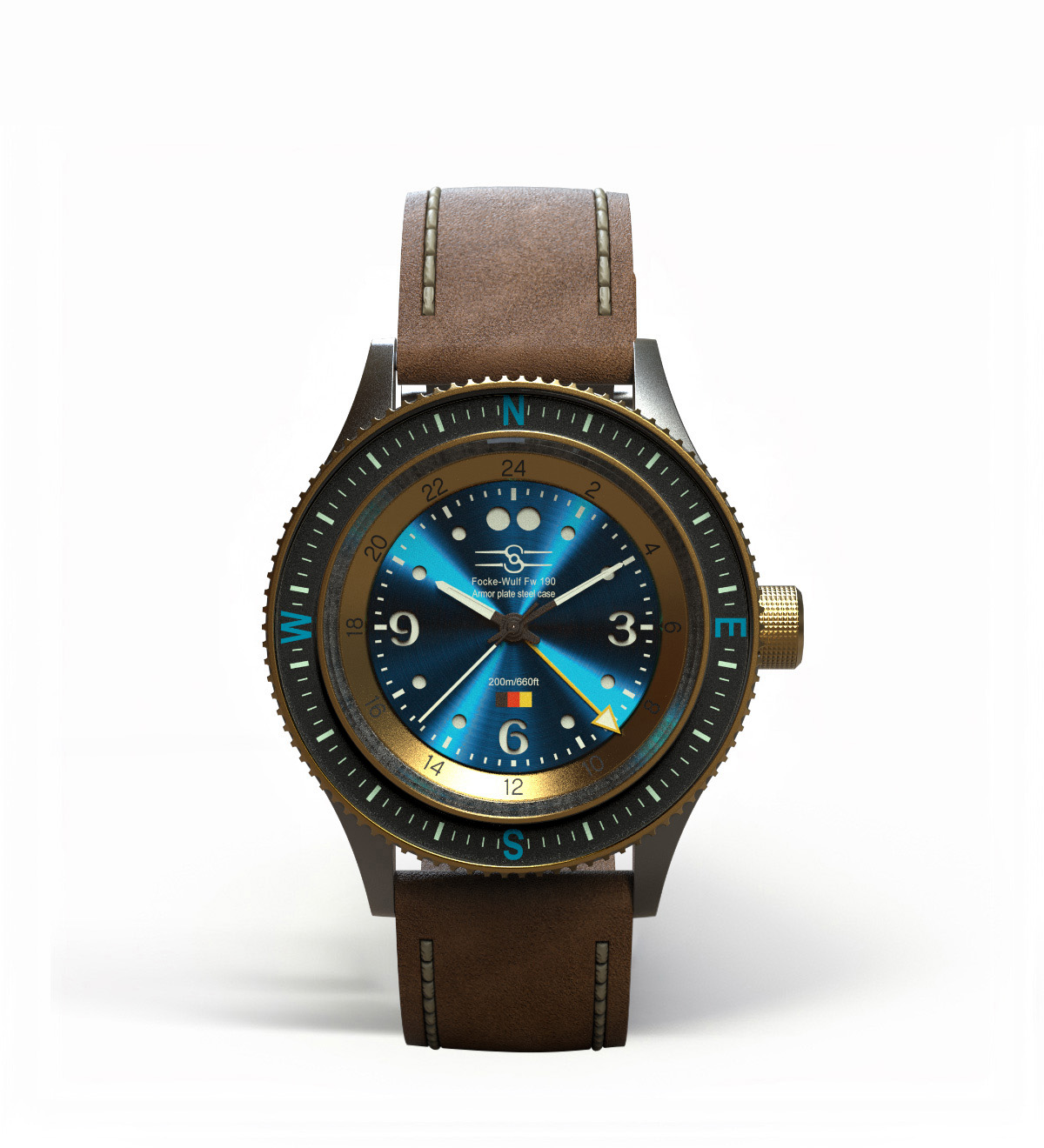
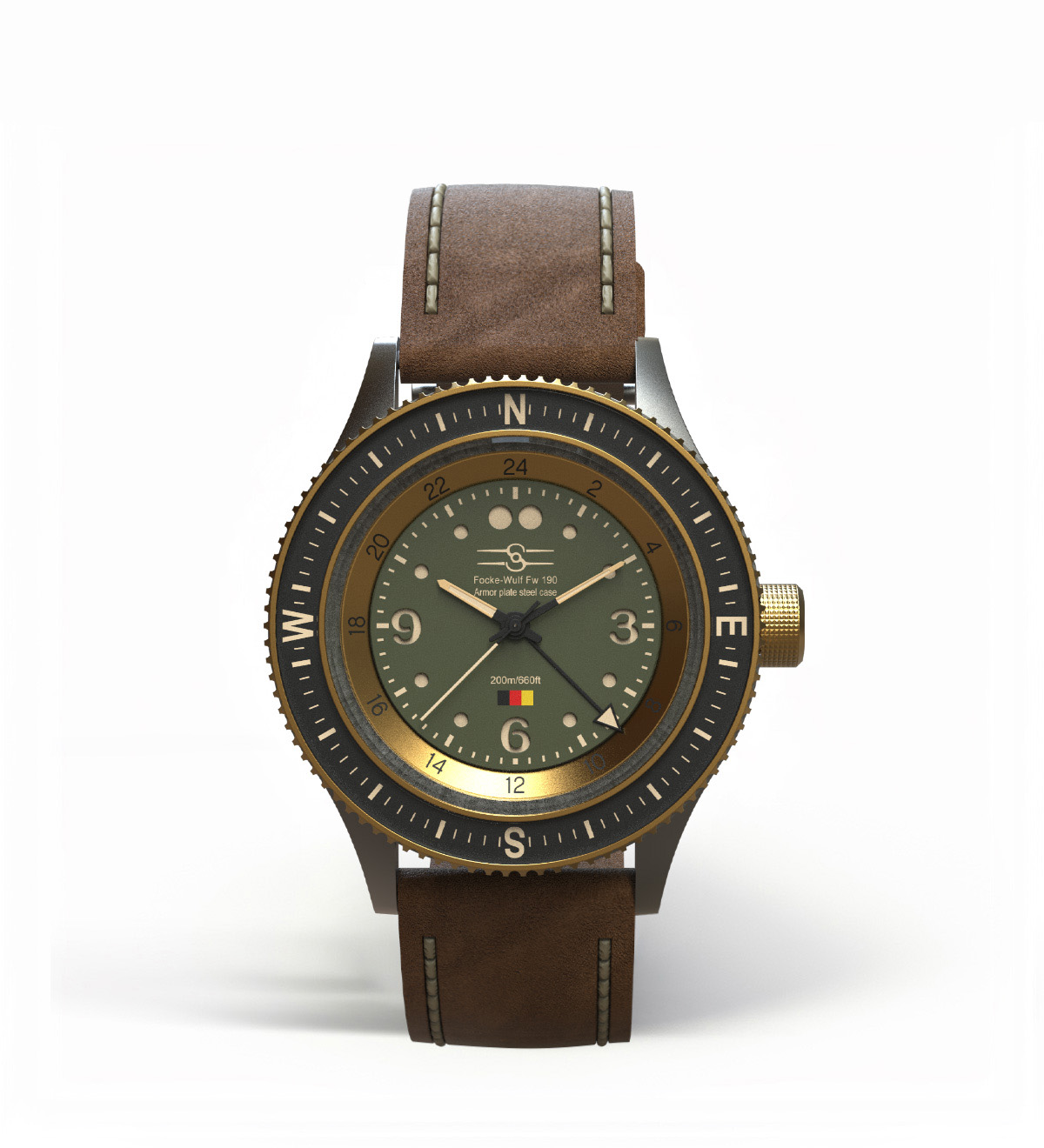
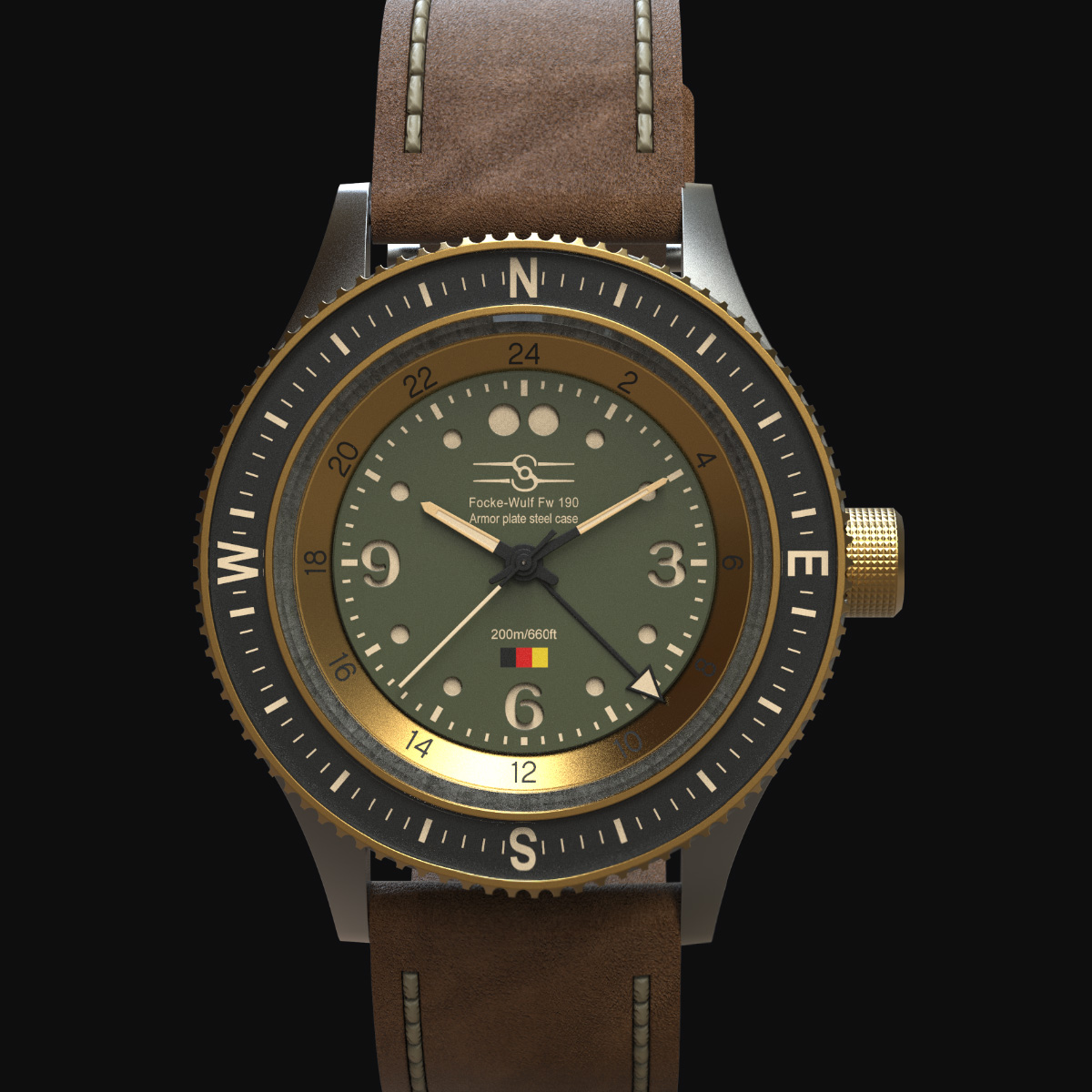
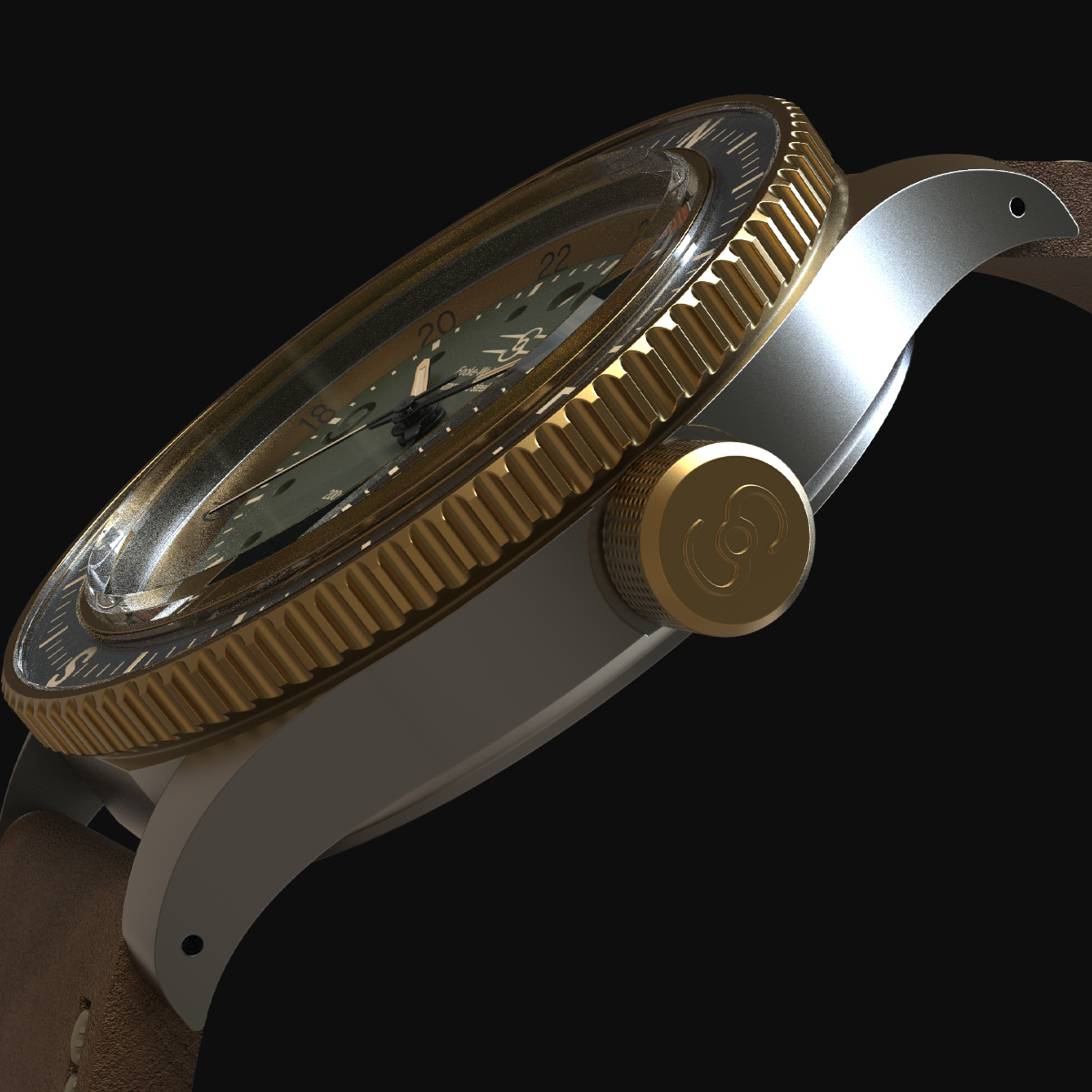
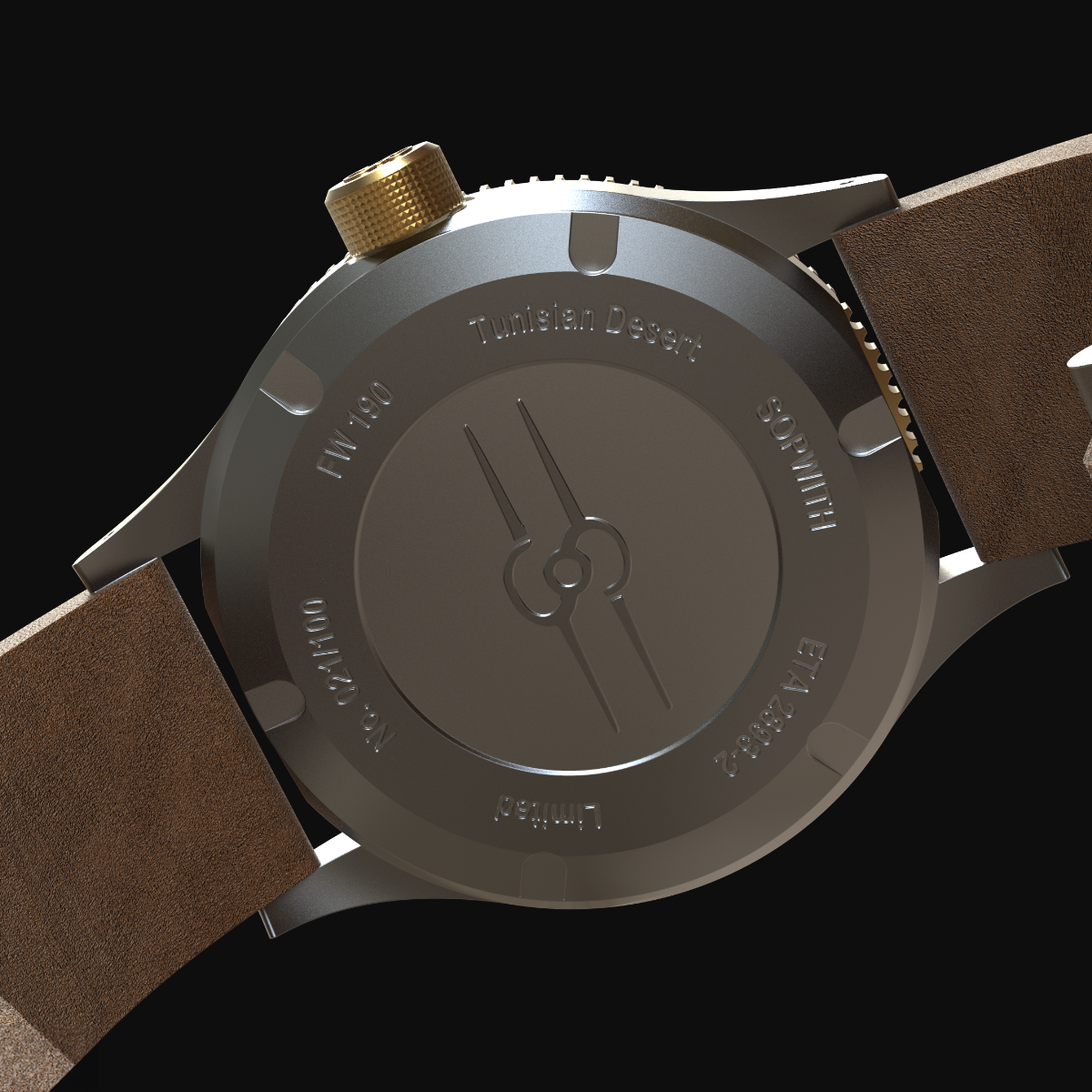
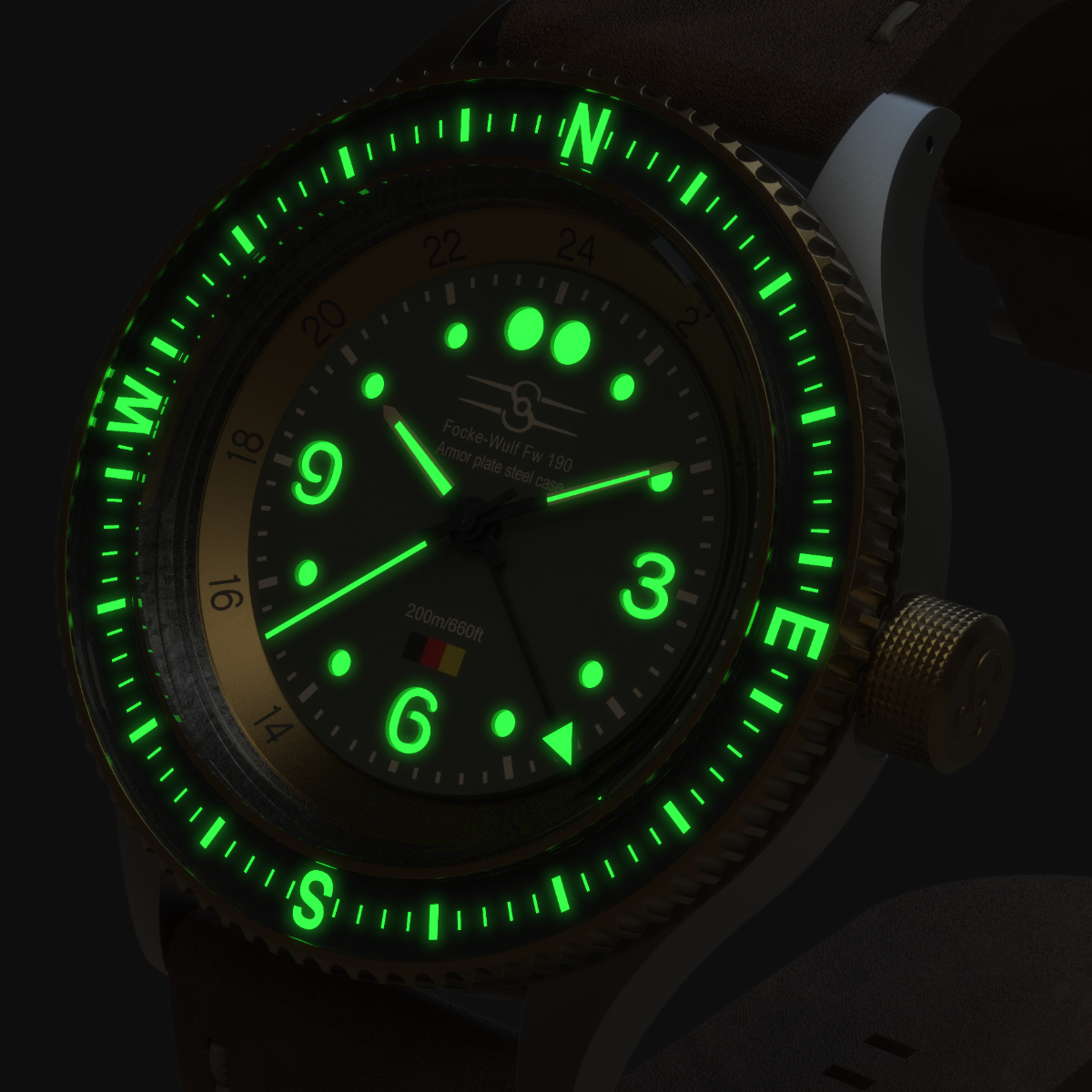
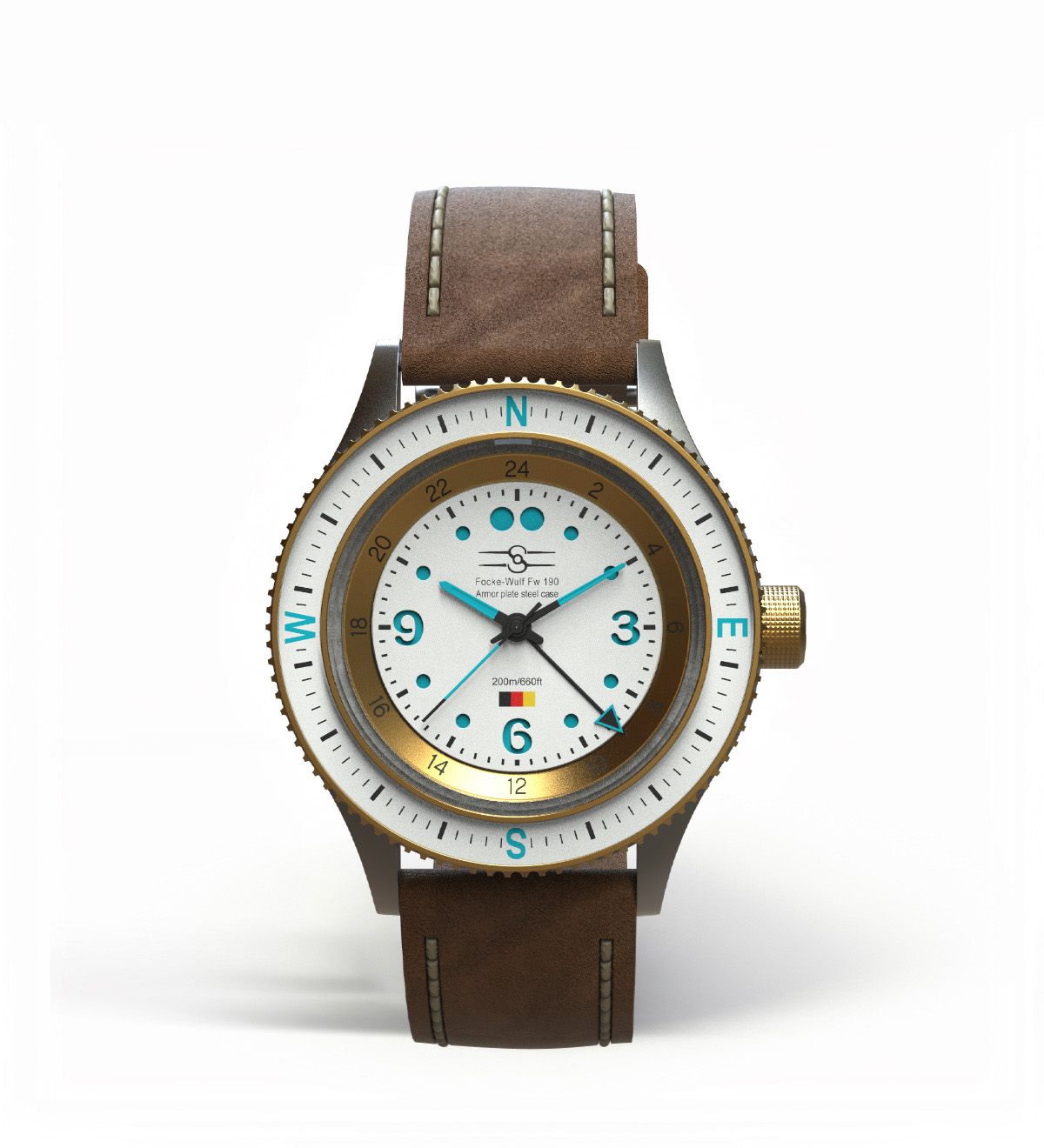
Focke-Wulf Fw 190
Tunisian Desert
Focke-Wulf Fw 190
Case made from:
Cockpit Armor Plating
41 mm case
$5,700.00
| Movement | Swiss automatic, 42-hour power reserve |
|---|---|
| Case Size | Ø 41.00 mm |
| Water Resistance | 200 meters |
| Strap Material | Stitched, hand-cut Horween leather |

Sopwith Aero Marquis
Focke-Wulf Fw 190 Series
Tunisian Desert Limited Edition
Written for Sopwith Watch Company by Barrett Tillman, award-winning author of “The Dauntless Dive-Bomber of World War II,” “When the Shooting Stopped: August 1945,” and more than 40 other books on World War II and the VietNam conflict
Renowned British Navy test pilot Captain Eric Brown rated the Focke-Wulf 190 as a world-class fighter, featuring “elegant lethality” with an unexcelled roll rate. He found little to choose between the FW-190 and the Spitfire Mk IX.
Brown knew Focke-Wulf’s guiding light, Dr. Kurt Tank – a polymath military, engineering and aviation talent. Following service as a World War I cavalryman, he learned to fly, worked for various firms, and settled at Focke-Wulf in 1931 as an engineer and test pilot. In 1938 the company chose him to design a contender for the Luftwaffe’s new fighter contract, and a happier melding seldom occurs.
First flown in 1939, the nascent FW-190 proceeded through engine teething problems before selecting the powerful, reliable BMW 801, a twin-row, 14-cylinder radial. When the FW 190A model debuted on the Channel Front in the summer of 1941, it immediately dominated the RAF’s Spitfire Mk V.
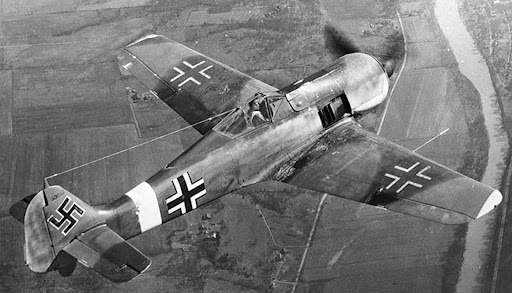 Lacking current intelligence, the British assumed that the radial-engine threat must be “some old Curtiss aeroplanes the Germans are using.” RAF legend Douglas Bader quipped, “If that was the case, we asked could we get some of those old Curtiss aeroplanes, please?” Actually, the Luftwaffe seldom flew captured French fighters such as the Curtiss Hawk 75 based on the P-36.
The Anglo-American landings in Morocco in November 1942 spurred the 190’s appearance in-theater, as Operation Torch opened the Wehrmacht’s western flank to strategic peril. The Allies pushed eastward into Tunisia where they encountered the 190 in a situation of Allied air superiority.
Flying over the open desert posed navigation problems similar to the sea. Long stretches with few landmarks could challenge everyone, including Focke-Wulf 190 pilots who sometimes flew long-range attack missions.
Flying weather in North Africa varied considerably. Though most days provided bright sunshine, the sandy expanse could produce massive dust storms – haboobs in Arabic – that obscured the sun.
Tactical aviation pilots and aircrews learned the advantages and disadvantages of operating in the theater. Generally the climate was pleasant with winter temperatures between the mid 40s to mid 60s Fahrenheit. Often with unlimited visibility, brilliant sunshine could gleam off canopy glass that became visible for miles, and when a plane’s camouflage paint blended with the terrain, there was no concealing a shadow flitting across the dunes.
The Focke-Wulf 190 Wurger (Shrike) was a rare “Butcher Bird” in British parlance, with a brief appearance in African skies. Apparently only two Luftwaffe groups flew the type in North Africa between November 1942 and May 1943 when the Axis Afrika Korps collapsed. The Gruppen detached from their parent commands were II/JG 2 and III/ZG 2 (originally a Bf 110 Zerstorer unit), redesignated III/SJG 10 in December.
The leading light of JG 2’s African deployment was Leutnant (soon Hauptmann, or Captain) Erich Rudorffer. A profligate claimer, he arrived with nearly 50 credited victories, and on January 8, 1943 he returned boasting of six P-40s and two P-38s in a half-hour combat. Five weeks later he repeated the claim with five P-38s and three Spitfires kills in an hour. When the Gruppe withdrew to France in early March, Rudorffer was credited with 26 victories in Africa. He ended the war flying Me 262s with some 220 Abschusse (kills).
Most 190s in North Africa were A models fitted with “tropical” air filters to operate in the region’s dust and sand. The few F and G ground-attack variants also received the “Trop” modifications. The close support variants were capable of carrying 250- and 500-kilogram (550 to 1,100 pound) bombs. And acknowledging the low-altitude AA threat, Schlachtflugzeug aircraft received additional armor plate.
A few other units took the 190 to Tunisia, flying reconnaissance missions as well as attack sorties.
The most heavily used bases were north and south of Tunis near the gulf, at la Fauconnerie and Sidi Ahmed, Kaiouan, Protville and El Aounia.
It was here that Royal Air Force pilot Benny Benham quickly learned of the Fw 190’s prowess in a dogfight along the North Africa coastline on January 2, 1943:
I followed down a [sic] Fw 190 which was diving at very high speed… I intended to cut across above him and nail him as he climbed up in front of me after pulling out of his dive. As I closed on him, he was obviously leaning back and watching me through the top of his cockpit hood, for as I was about to open fire, the fighter suddenly skidded violently to one side. It then skidded the other way and pulled over my head, ending up on my tail.
The Focke-Wulfe pilot turned the tables on his opponent and opened fire. Benham’s Supermarine Spitfire was riddled and he was lucky to escape with his life.
In Tunisia the Luftwaffe faced Royal Air Force and U.S. Army Air Forces opponents often flying the same aircraft, notably the Supermarine Spitfire and Curtiss P-40 Kittyhawk. The Allies’ three fighter weapons were British .303 and U.S. .50 caliber machine guns plus limited use of 20mm cannon.
Focke-Wulf pilots sat behind a 50mm (1.9 inch) armored glass windscreen, sloped at 50 degrees to reduce penetration much as tank armor often did. The seat was protected by 8mm (0.31 inch) armor on the back with a 13mm head and shoulder pattern plus 8mm plates above and below the seat pack and on the sides.
American fighters did not clash with 190s until early December, and seldom thereafter. In the following five months U.S. squadrons only claimed 40 Wurgers before the Tunisian campaign ended.
Over North Africa the Spitfire was the Wurger’s worst enemy among American fighter pilots. The 31st led the other six fighter groups with fifteen FWs credited as destroyed. Therefore overall, with the 52nd Group, Spitfires accounted for twenty-two of the U.S. total, followed by twelve for P-38 units and six flying P-40s.
The lone American ace against 190s in Tunisia was First Lieutenant J.D. Collinsworth, a 31st Fighter Group Spitfire pilot.
Collinsworth’s first 190 encounter provided an invaluable lesson. Spotting a Focke-Wulf below, he maneuvered to attack from behind, then remembered a briefing: “Where there’s one German, there’s two.” The young Texan turned in his cramped cockpit and saw the wingman closing in. He evaded with the lesson firmly in mind and shot down a Focke-Wulf a month for six months.
Six other USAAF pilots were credited with two FWs apiece in North Africa.
In the period that 190s were active in North Africa, Luftwaffe aircraft wastage was severe. Overall, the German air force lost more than 2,200 planes with attrition often exceeding two hundred percent per month. Fighters were particularly hard hit, reaching two-thirds of authorized strength. Nevertheless, the FW 190 exerted an influence on Allied pilots beyond its scale of issue.
The Sopwith Focke-Wulf Fw 190 Tunisian Desert Limited Edition timepiece, produced from the armor of an original Focke-Wulf Fw 190, recalls that rare legacy.
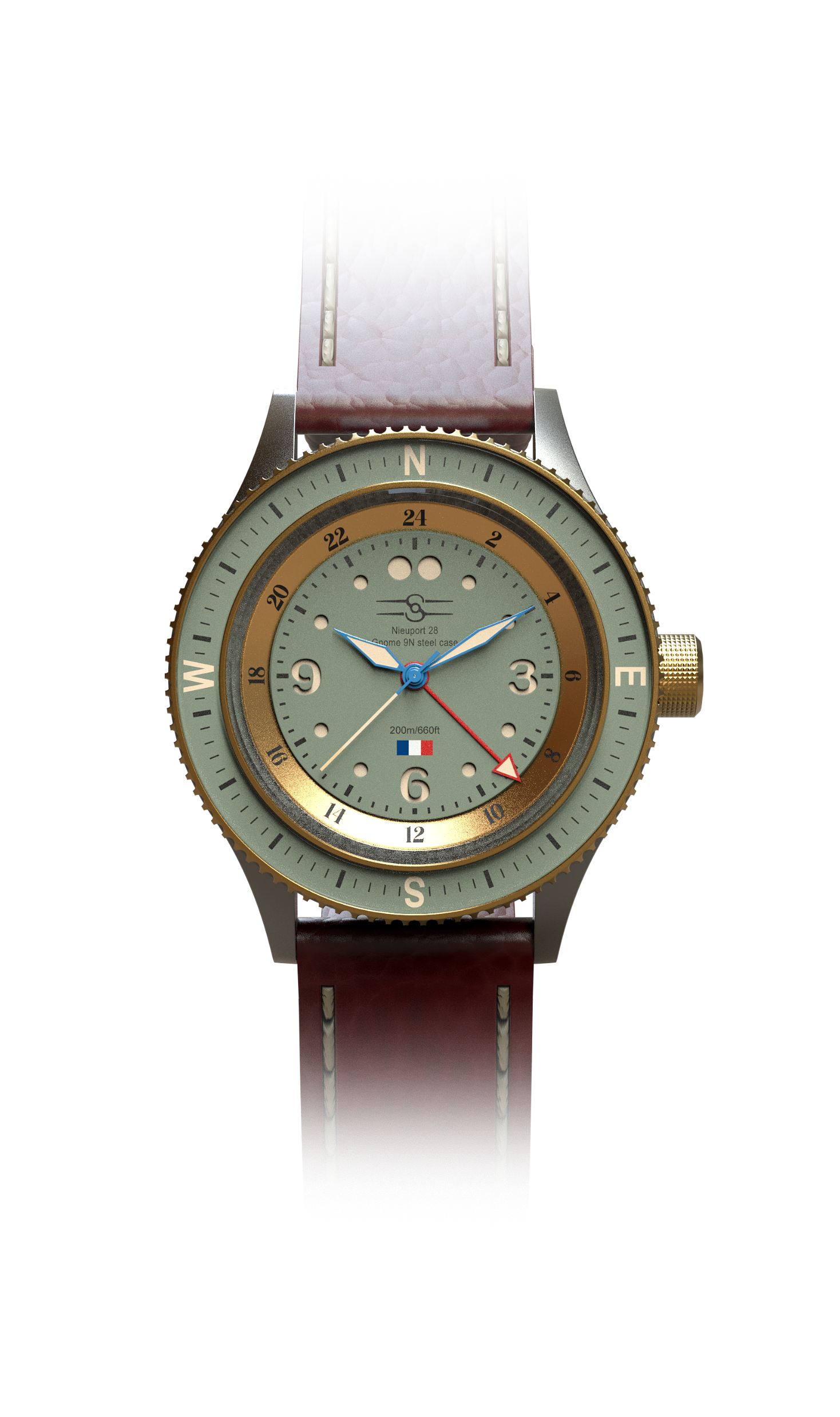
Related products
-
Limited to 30 watches.
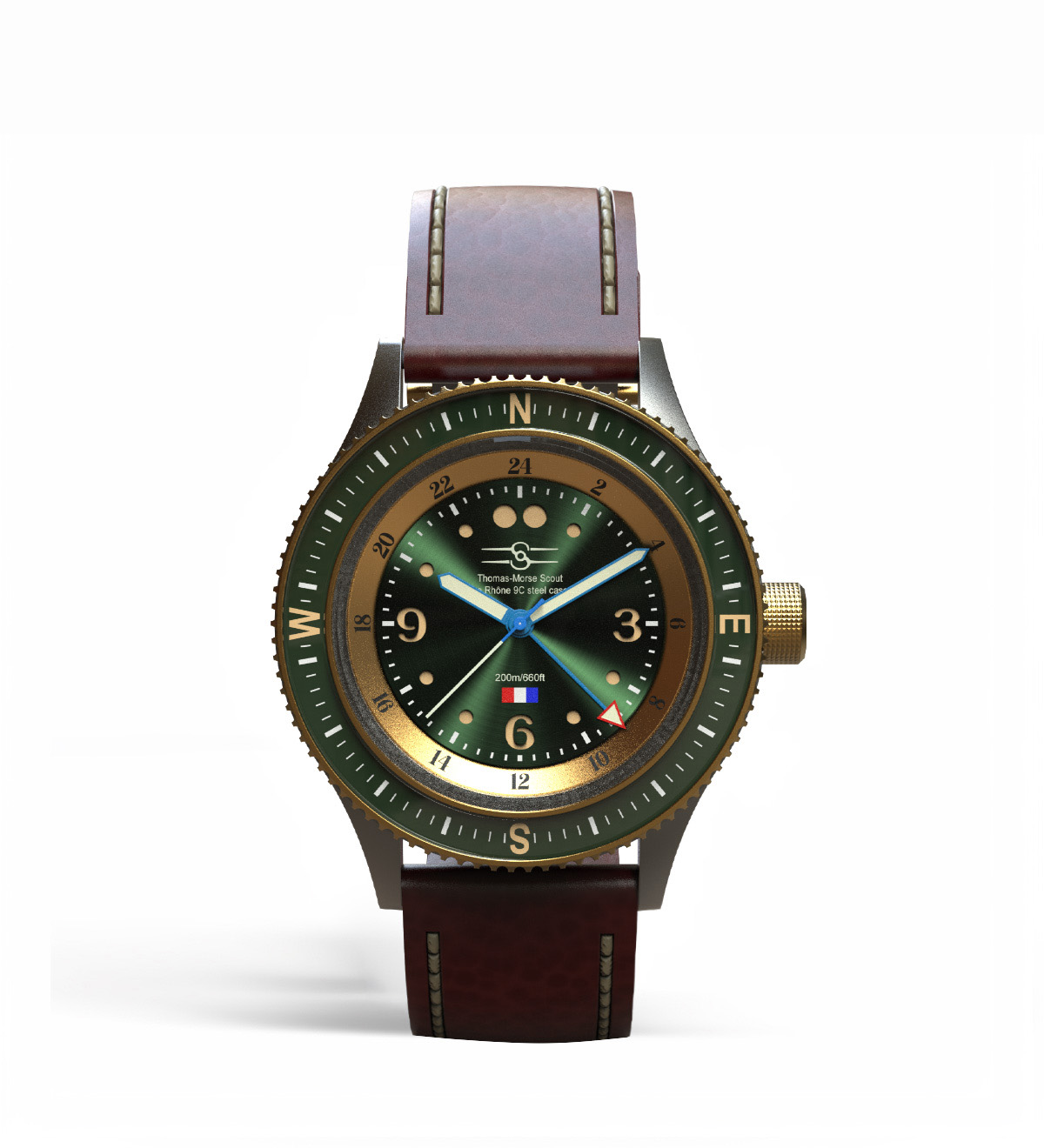
-
Limited to 55 watches.
-
Limited to 55 watches.